
Clay County Criminal Court Cases
Clay County belongs to Illinois' Fourth Judicial Circuit. The Circuit Court of the Fourth Judicial Circuit, Clay County, has original jurisdiction over local felony and misdemeanor prosecutions. It also handles traffic and ordinance matters. There is no separate city municipal court with an independent criminal docket. Cases that begin with police work in Flora, Louisville, Clay City, or an unincorporated area move into the same county circuit system once the State's Attorney files charges.
The Clay County Circuit Clerk is the court-file custodian. Its counter is at the Clay County Courthouse, 111 E. Chestnut Street in Louisville, with mail directed to P.O. Box 100, Louisville, IL 62858. Call (618) 665-3523 before travel when an old, restricted, or paper-only file may be involved. The clerk preserves pleadings, orders, docket entries, financial records, and the final disposition. Police narratives remain with the investigating agency.
The Illinois Courts description of circuit courts shows why the local clerk is central to a Clay County case search. The circuit structure places the complete judicial trail in one county file even when a different law-enforcement agency made the arrest.
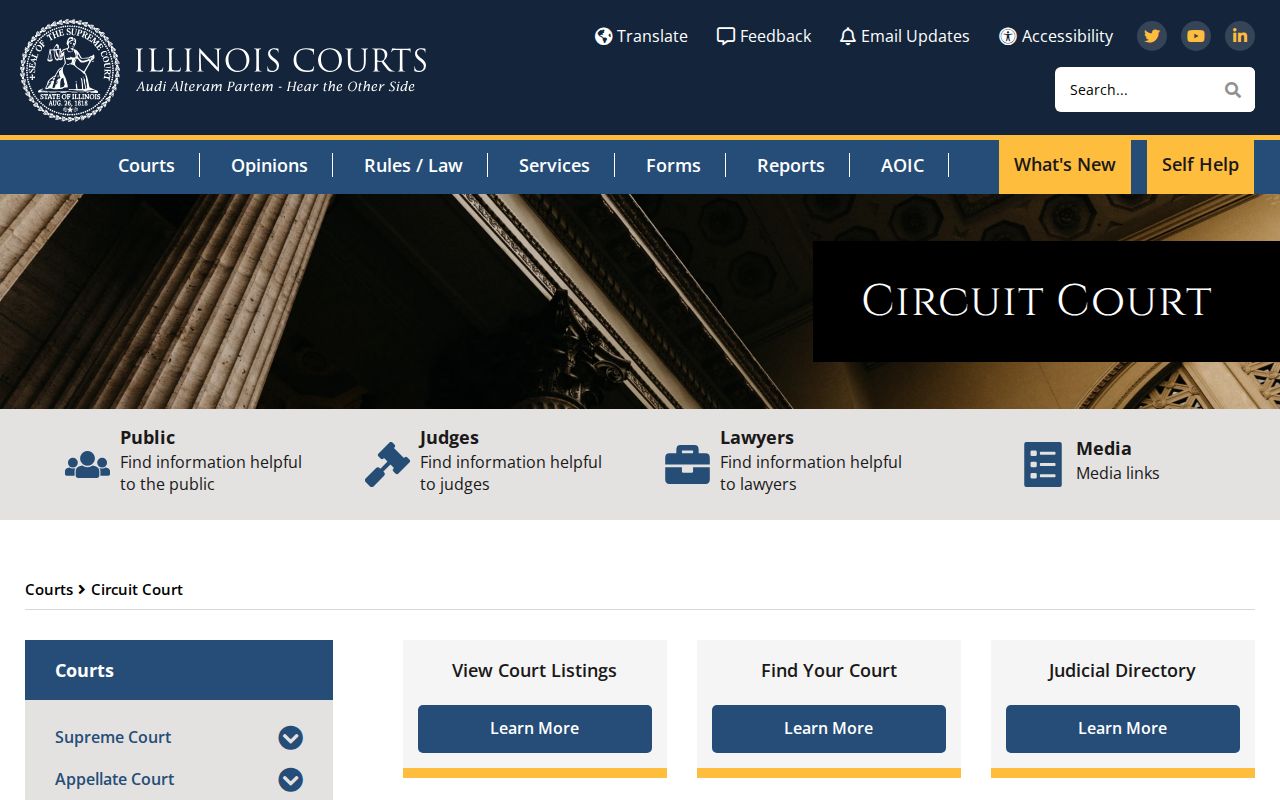
This statewide court structure explains why a city arrest can produce a Louisville courthouse file.
Search Clay County Judici Records
Clay County's official website routes its “Search Court Records” link to the Clay County Judici case index. Judici is the most direct remote starting point for a case number, filing date, status, parties, charges, docket events, future settings, dispositions, and financial entries that are available to the public. It is an index, not a certified court record and not the Illinois State Police criminal-history repository.
The Clay County Judici search opens in the county court context. Searchers should follow current on-screen controls because the interface can change.
The county selection helps prevent results from another Illinois court from being mistaken for a Clay County file.
| Search field | Use | Required | Practical note |
|---|---|---|---|
| Court | County context | Yes | Clay County is selected by the county link |
| Last Name | Name search | Usually | Common surnames need more detail |
| First Name | Narrow results | No | Use the known spelling |
| Middle Name | Narrow results | No | An initial can separate similar names |
| Case Number | Exact lookup | Alternative | Best cross-reference when known |
Searching Clay County Case Records
A name search can identify a likely docket, but an exact case number is safer. It follows the matter through the prosecutor, Circuit Clerk, probation office, and any later expungement or sealing request. A date of birth should not be assumed to be a public search field. Match the case by available filing dates, charge descriptions, and events, then confirm identity with the clerk when doubt remains.
- Open the county-linked Judici interface and confirm Clay County appears as the court.
- Search by exact case number, or enter the last and first name.
- Compare filing date, case type, status, parties, and charge counts.
- Read each docket event and the outcome for every count.
- Ask the Circuit Clerk for the filed document or a certified disposition.
Older paper files, documents that were never imaged, and protected matters may not appear online. The clerk provides a public terminal at the courthouse. A search costs $6 per name. Written requests must include payment and a self-addressed stamped envelope. Ask for a copy estimate and certification charge before ordering a long file.
Clay County Certified Dispositions
A certified disposition is often more useful than a printed search result. It shows the court's authenticated outcome and can resolve uncertainty when an index says only “closed.” Send the clerk the person's name, approximate year, and case number if known. The published copy schedule is $2 for the first page, 50 cents for each of the next 19 pages, and 25 cents for each later page. Computer-generated information is $6 per page.
The clerk does not accept personal checks from individuals or self-represented filers for the listed court payments. Confirm an accepted payment method before mailing. Certification is separate, so state exactly what is needed. A request for “everything” can add delay and cost. Asking for the judgment, sentencing order, or certified disposition gives staff a clearer target.
Inside a Clay County Case File
The file records what prosecutors charged and what the court did. Charges can change after booking. The State's Attorney may reject an allegation, amend a count, add a count, negotiate a plea, or dismiss a charge. Read each count's disposition rather than treating the case-level status as the whole answer.
| Case header | Case number, filing date, county, case type, and status. |
|---|---|
| Parties | The State of Illinois, defendant, and attorneys when shown. |
| Charges | Count, description, statute, level, dates, and count-level outcome. |
| Docket events | Filings, appearances, pleas, motions, hearings, continuances, judgment, and sentencing. |
| Schedule | Next date, time, courtroom, or judge when published. |
| Financial entries | Assessments, payments, balances, and bond-related entries when available. |
A docket entry announces that something happened. It does not guarantee that the motion, exhibit, transcript, or signed order is downloadable. Request the underlying item from the clerk. The broader difference between arrest material and the later court file is also explained on the Clay County arrest lookup page.
Booking Charges and Filed Counts
An officer's arrest report lists offenses believed at the time of custody. The prosecutor then reviews that evidence and decides what to file. The court case therefore may have fewer, more, or differently worded counts than the booking entry. Both documents can be accurate for their own stage.
A closed case is not a single outcome. One count may end in conviction while another is dismissed. Supervision, acquittal, dismissal, and a negotiated plea have distinct effects. For record relief or correction, obtain the certified count-level disposition. Do not ask the sheriff to change a court entry or the clerk to rewrite a police report. Each custodian controls its own record.
How a Criminal Case Moves
Clay County criminal case records grow as the prosecution advances. Early results can be sparse because a recent arrest may not yet have a filed case, while later entries may reflect amendments and final orders.
The State's Attorney files charges, and the court addresses an appearance and plea. Pretrial work may add motions, hearings, discovery disputes, or continuances. A plea or trial resolves liability. The judge then enters judgment and any sentence. Qualifying outcomes are reported to the Illinois State Police so the repository can match the disposition to its arrest cycle.
Remote criminal and traffic appearances require permission. The clerk publishes a Zoom credential, but publication does not authorize a person to appear remotely. Confirm the date, courtroom, and judicial permission with the clerk.
Clay County Court Terminal Access
The courthouse terminal can add access when Judici omits an older entry or when the needed record is not available from home. It does not override sealing, expungement, juvenile confidentiality, impoundment, or privacy rules. Bring a case number when possible and ask staff which public documents can be inspected or copied.
Clay County's official document library supplies another county source for forms and departmental materials, though it is not the criminal docket.
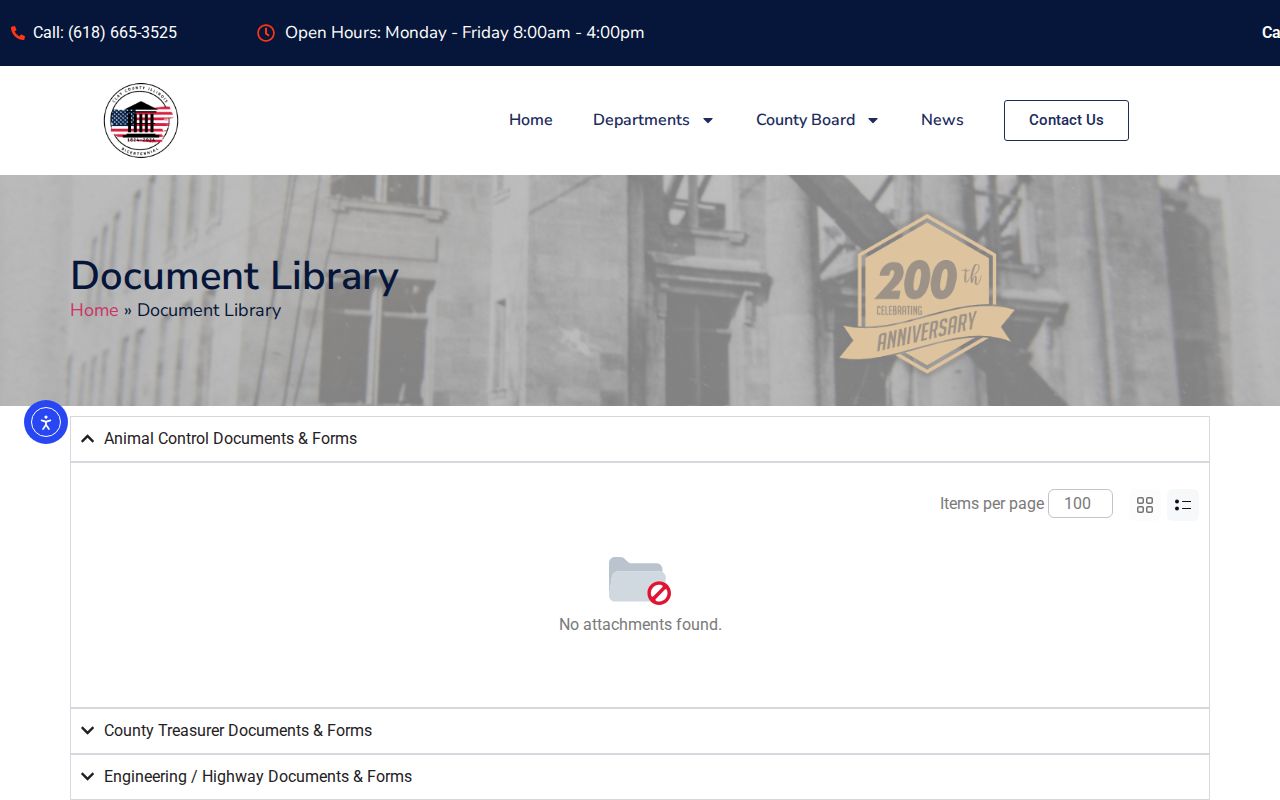
The library can help locate forms, while the Circuit Clerk remains the source for a specific criminal case file.
Case Record Access and Restrictions
Public does not always mean published online. Court records follow judicial access and recordkeeping rules. Illinois Freedom of Information Act requests are appropriate for executive agencies such as a sheriff or police department, but FOIA is not the ordinary route to court files. Use the Circuit Clerk for pleadings, orders, dockets, and certified dispositions.
Sealed, expunged, impounded, juvenile, adoption, and other protected matters may be absent or limited. Birth dates, Social Security numbers, victim details, protected addresses, and sensitive identifiers should not appear in a public view. An old or missing online result can also mean a paper-only file, not a secret case. Ask the clerk which explanation applies without expecting restricted content to be released.
CHIRP offers statewide public conviction information under the Uniform Conviction Information Act, but a name result has less local case detail and is not fingerprint-confirmed identity. For review of one's own fuller Illinois record, ISP Access and Review uses a licensed live-scan fingerprint vendor. Court-docket errors go to the clerk and court; repository mismatches go through ISP's challenge process.
Clay County Fourth Circuit Context
The Fourth Judicial Circuit setting matters because the county is part of a broader Illinois circuit without losing local file custody. Clay County's Circuit Clerk still maintains the local prosecution record. A federal criminal prosecution is separate and belongs in the U.S. District Court for the Southern District of Illinois, with PACER as the federal docket system.
Likewise, a sheriff report, an ISP conviction response, and a court docket answer different questions. Start with Judici for a Clay County case number and public events. Move to the clerk for the signed record. Use the arresting agency for the narrative and ISP for the state repository product. That sequence prevents one limited result from being mistaken for a complete history.